
TL;DR:
- Using dedicated apps helps fans discover mutual concert connections safely and privately.
- Logging detailed past shows enhances ability to find others with shared experiences.
- Real connections often stem from storytelling and shared memories over algorithm-based matches.
You've stood shoulder to shoulder with thousands of strangers at a sold-out show, singing every word, feeling that shared electricity. Then it's over, and those people vanish into the night. What if some of them are already in your social circle, or just one app away? Many fans attend the exact same concerts without ever realizing it, missing out on friendships built on the most powerful shared language there is: live music. This guide walks you through the tools, steps, and strategies to discover mutual concert connections, log your history, and build a real community around the shows you love.
Table of Contents
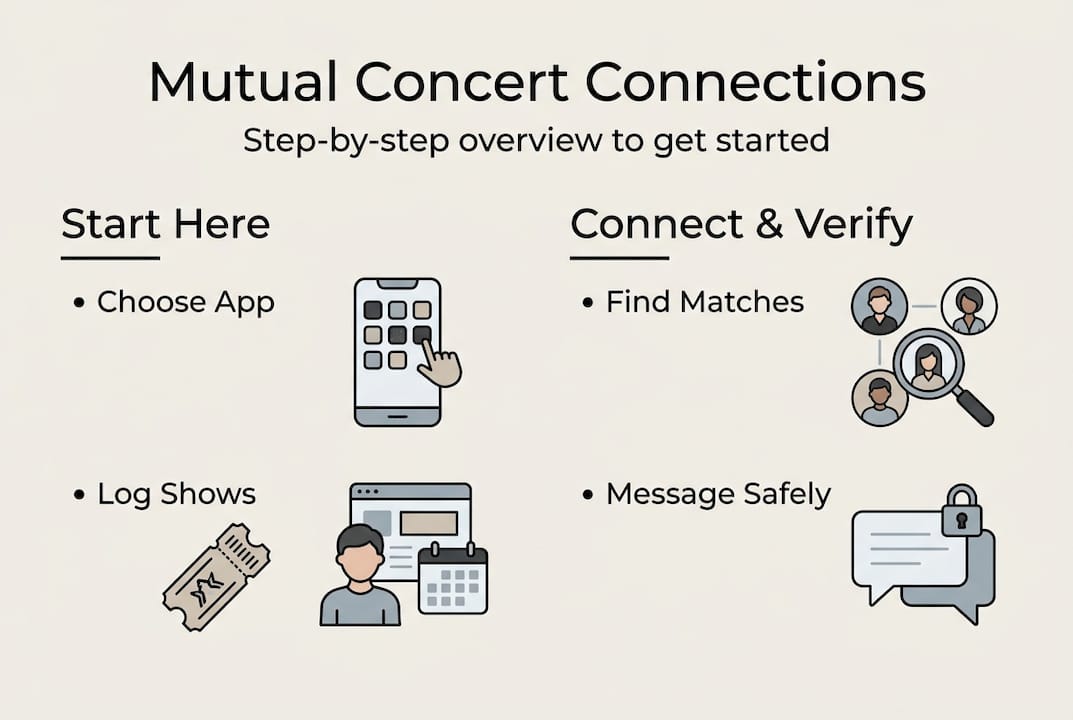
- What you need to get started
- Step-by-step: Logging your concert history
- How to find and verify mutual concert connections
- Community-driven and last-minute connections
- Comparing top apps for mutual concert connections
- Why real concert connections are more rewarding than algorithms
- Ready to track and connect? Try Gigvault
- Frequently asked questions
Key Takeaways
| Point | Details |
|---|---|
| Choosing the right app | Select a platform that matches your privacy preferences and connection style. |
| Accurately log your attendance | The more details you record, the easier it is to discover genuine mutuals. |
| Use community resources | Fan forums and event chats are great for last-minute or solo connections. |
| Prioritize safety | Always meet in public and use app verification features to protect yourself. |
What you need to get started
Now that you know why connecting over concerts matters, let's make sure you have the right tools and setup.
Before you can find fellow fans who were at the same shows, you need a solid foundation. Think of it like packing your bag before a festival. You wouldn't show up without your ticket, so don't start this process without the right apps and account details ready.
Essential tools to gather:
- A dedicated concert tracking app such as Gigvault, Concert Archives, or Common Sound
- Your email address to create accounts
- A list of past concerts (dig through old ticket stubs, photos, or your email inbox)
- Linked music profiles from Spotify or Apple Music, where supported
- Any saved setlists or venue receipts that confirm attendance
The primary methods to discover mutual concert connections involve using dedicated apps and platforms built specifically for this purpose. General social media can help, but purpose-built tools give you far more accuracy and privacy control.
App comparison at a glance:
| App | Main feature | Privacy default |
|---|---|---|
| Gigvault | Memory logs, mutual connections | Mutual-only |
| Concert Archives | Show history, friend follow | Public optional |
| Common Sound | Taste and event matching | Customizable |
Privacy matters a lot here. Some platforms show your concert history publicly by default, which is great for discovery but not for everyone. Gigvault, for example, only surfaces your history to mutual connections, so you control who sees your archive. If you're logging concerts in a city like Assago, you can track local show history without broadcasting it to strangers.
Pro Tip: Before signing up for any app, check its privacy settings first. Look for options like "mutual-only visibility" or "friends only" to keep your data safe while still enabling connection features.
Step-by-step: Logging your concert history
Once you've chosen your preferred app, it's time to build your concert diary.
Your concert log is the engine behind every mutual connection you'll make. The more detail you add, the better the app can match you with fans who share your history. Here's how to do it right.
- Create your account and link your Spotify or Apple Music profile if the app supports it. This auto-suggests shows based on artists you already follow.
- Search for past shows by artist name, venue, or date. Apps like Concert Archives let you browse by year, so you can scroll back through your history easily.
- Add venue and date details for every show. A log that says "saw Radiohead" is far less useful than one that includes the venue, city, and exact date.
- Upload photos or notes if the app allows it. This adds a personal layer and helps verify your attendance when comparing histories with others.
- Mark upcoming shows as attending or interested. This is how apps surface real-time connections before a concert even happens.
What to include for each show:
| Detail | Why it matters |
|---|---|
| Date | Confirms shared attendance |
| Venue | Narrows location overlap |
| Headliner and support acts | Matches fans of specific artists |
| Your notes or rating | Adds personal memory context |
The mechanics behind apps like Concert Archives and Gigvault let users log past and upcoming concerts, follow friends, and compare histories for overlaps. Retroactively adding festival lineups is especially powerful. Think back to that muddy field in 2019 and add every act you caught. Fans who were at Zenith for the same night you were could show up as a mutual connection.
Pro Tip: Start with your top 10 most memorable shows and work outward. A focused, detailed log beats a rushed, incomplete one every time.
How to find and verify mutual concert connections
With your concert history recorded, you're ready to meet fellow fans with shared memories.
Logging shows is only half the fun. The real payoff is discovering that someone in your extended network was standing 20 feet away from you at the same show three years ago.
- Browse the mutual connections tab in your app. Gigvault surfaces fans who share your show history without a public feed, keeping things intentional.
- Check shared playlists or linked music profiles to verify that the overlap is genuine and not just a coincidence of popular artists.
- Look for photo proof in shared logs. If someone uploaded a photo from the same night at the Showbox, that's a strong confirmation.
- Use in-app messaging to introduce yourself. Keep it light, mention the specific show you both attended, and suggest a public meetup if the conversation goes well.
"The best concert friendships start with a simple 'Hey, were you at that show too?' It's the most natural icebreaker in the world."
Established platforms like Bandsintown and Concert Archives enable tracking but offer limited direct mutual discovery compared to newer tools. That's why cross-referencing apps can help. Use one platform for discovery and another for deeper memory logging.

Never share personal contact information immediately. Stick to in-app messaging until you've verified the connection through shared show details, mutual friends, or photo evidence. Safety first, always.
Pro Tip: When reaching out to a mutual connection, mention a specific detail from the show you both attended, like a surprise encore or an opening act. It instantly proves you were really there and makes the conversation feel genuine.
Community-driven and last-minute connections
Beyond dedicated apps, there are creative ways the community connects spontaneously, even last-minute.
Sometimes the best concert friendships happen in the most unexpected ways. You don't always need a perfectly curated app profile to find your people.
Where to look for spontaneous connections:
- Reddit threads for specific artists or venues, especially r/indieheads, r/concerts, or city-specific subreddits
- Discord servers run by fan communities, where event-specific channels pop up before big shows
- Facebook event pages for the concert itself, where fans often post about meeting up
- App-based group chats within platforms like Common Sound or Gigvault, organized around specific events
- Venue social media posts tagged with the show's hashtag
For fans attending events at venues like Piazza Palio, local community boards and city subreddits can surface last-minute connections quickly.
"Going solo to a concert used to feel lonely. Now it's an invitation to meet the most passionate fans in the room."
One of the best examples of community-driven connection is the Symphony Pals story, where a solo attendee posted on Reddit looking for a concert buddy and ended up founding a lasting community group. That's the power of putting yourself out there.
When meeting new people from online forums, always arrange the first meetup in a public space inside the venue, like the merch line or the main bar area. Tell a friend where you're going. Good etiquette goes a long way too: be upfront about your intentions, keep early messages friendly and low-pressure, and respect boundaries if someone isn't interested in connecting further.
Comparing top apps for mutual concert connections
With so many platforms available, use this comparison to choose what fits your concert connection style.
| App | Key connection features | Privacy model | Best use case | Free/Paid |
|---|---|---|---|---|
| Gigvault | Mutual connections, memory logs, AI Music Identity | Mutual-only, no public feed | Stat trackers and memory keepers | Free |
| Concert Archives | Show history, friend follow, photos | Public or friends-only | Building a detailed show archive | Free |
| Common Sound | Taste and event matching, group chats | Customizable | Meeting fans at upcoming shows | Free |
| Bandsintown | Event tracking, artist alerts | Public | Discovering and tracking upcoming events | Free |
| StageHop | Concert friends, event-based matching | Semi-public | Finding show partners quickly | Free |
Newer apps like StageHop and Common Sound are emerging alongside veterans like Bandsintown, giving fans more options than ever. Check out StageHop if your priority is finding a show partner fast.
Quick recommendations by fan type:
- Stat obsessives who want detailed recaps and achievements: Gigvault
- Social butterflies who want to meet fans before a show: Common Sound or StageHop
- History buffs building a complete archive: Concert Archives
- Discovery-first fans who want alerts and event feeds: Bandsintown
For fans who attend shows at venues like Werk, a combination of Gigvault for memory logging and Common Sound for pre-show social discovery tends to work best. You get the depth of a personal archive and the reach of a social platform.
Why real concert connections are more rewarding than algorithms
After comparing tools, it's worth stepping back to consider what really matters when finding your concert community.
Algorithms are good at surfacing names. They're not so good at surfacing meaning. When an app tells you that you and a stranger both like the same artist, that's interesting. When you discover you were both at the same tiny club show on a rainy Tuesday night five years ago, that's a story.
The emotional weight of an unexpected concert overlap is hard to overstate. It's the difference between "we have similar taste" and "we shared that exact moment." Those serendipitous discoveries, cross-checked with photos, setlists, and half-remembered memories, create bonds that feel earned rather than manufactured.
We've seen this play out in the Z-Bau live memories community and in countless fan groups that started with a single shared show. The human side of concert connection, the stories, the inside jokes about that one song they played third, always outlasts the algorithmic match.
Focus on the details when you reach out to a mutual connection. Don't just say you attended the same show. Talk about what you remember. That's where real friendships start.
Ready to track and connect? Try Gigvault
If you're ready to put these strategies into action, here's a way to start right now.
Gigvault is built exactly for fans like you. Whether you're a stats-driven tracker or someone who just wants to find the person who was singing along next to you at your favorite show, Gigvault has the tools to make it happen.
Explore the full Gigvault features to see how mutual-only connections, AI-generated Music Identity, and detailed show archives work together. Start your concert diary to log every show you've ever attended, from your first gig to last weekend. If festivals are your thing, the festival tracker helps you organize every set you caught. No public feed, no algorithm noise. Just your music memories and the people who share them.
Frequently asked questions
How private are mutual concert connection apps?
Most platforms offer privacy controls including mutual-only visibility, with apps like Gigvault and Common Sound allowing users to restrict who sees their concert history. Gigvault specifically uses a mutual-only model with no public feed.
Can I find concert buddies for solo shows last minute?
Yes, many fans use Reddit, Discord, or app-based forums to safely connect with other solo attendees even on the day of an event. The Symphony Pals community is a great example of how a single Reddit post can turn into something much bigger.
What's the difference between event-matching and taste-matching?
Event-matching connects you with people attending the same concert, while taste-matching finds mutual fans based on shared music preferences. Apps like Common Sound support both approaches, letting you choose what kind of connection you're after.
Is it safe to meet up with mutual concert connections?
To stay safe, use app messaging tools first and arrange meetings in public spaces inside the venue. The Symphony Pals approach of meeting in a well-lit public setting and telling a friend your plans is a smart model to follow.