
Imagine finding out that someone attended 289 concerts in 365 days and earned a Guinness World Record for it. That's exactly what Tim Schaefer did, and his story is just the most extreme version of something thousands of fans are quietly doing right now: tracking every show, logging every setlist, and celebrating personal milestones along the way. Live show achievements are a real thing, and they're changing how passionate concert-goers experience live music. This guide breaks down what they are, which platforms support them, and how you can start building your own concert legacy today.
Table of Contents
- What are live show achievements?
- The platforms: How fans track achievements
- How achievements work: The mechanics of logging and milestones
- What counts? Stats, badges, and the edge cases
- Achievement in action: World records and superuser stories
- How to get started with your own live show achievements
- Take your concert journey further with Gigvault
- Frequently asked questions
Key Takeaways
| Point | Details |
|---|---|
| Live show achievements basics | Achievements are personal milestones and stats tracked via concert apps, turning experiences into memorable records. |
| Wide range of platforms | Apps like Setlist.fm, Concert Archives, and Encore each offer unique tools, stats, and logging features. |
| Logging mechanics matter | Fans log concerts through app integrations, GPS, and notes to build rich, accurate achievement histories. |
| Community and inspiration | World record holders and lifelong fans show the power and motivation of sharing concert achievements. |
| Start your journey now | Anyone can begin tracking their concerts with modern platforms and unlock new ways to celebrate every show. |
What are live show achievements?
Live show achievements are personal milestones you earn by attending and documenting concerts. Think of them like badges or stats that reflect your real-world dedication as a fan. Some platforms make this explicit with gamified rewards. Others let your raw numbers do the talking.
Concert tracking platforms like Setlist.fm, Concert Archives, and Encore have built entire ecosystems around this idea. According to the app store listing, live show achievements refer to personal milestones and gamified badges that fans use to document attendance, track stats, and share experiences with others.
Here's what those achievements typically look like in practice:
- Total concerts attended across your lifetime
- Unique artists seen live, from local openers to stadium headliners
- Venues visited, including cities and countries
- Average show ratings based on your personal reviews
- Streaks and milestones, like attending your 10th or 100th show
"Every show you attend is a data point in a story only you can tell. The stats just help you see the full picture."
The social dimension matters too. Sharing your concert count or a milestone moment connects you with other fans who get it. It's not about bragging. It's about belonging to a community that values live music as deeply as you do.
The platforms: How fans track achievements
Now that you know what live show achievements are, let's look at the tools fans actually use. Each platform has its own strengths, and the right one depends on what you want to get out of tracking.
Platforms like Concert Archives, Setlist.fm, Encore, and ConcertCritic provide stats such as total concerts attended, artists seen, venues visited, average ratings, and graphs of activity over time. These live music insights can be surprisingly motivating once you start seeing your history laid out visually.

Here's a quick comparison of the major platforms:
| Platform | Key feature | Verification | Social sharing |
|---|---|---|---|
| Setlist.fm | Setlist database, attended toggle | Honor system | Community-based |
| Concert Archives | Lifetime stats, detailed graphs | Honor system | Limited |
| Encore | Flashback notifications, photo uploads | Optional GPS | Yes |
| ConcertCritic | GPS check-in, ratings | GPS required | Yes |
| Gigvault | Memory archive, AI Music Identity | User-driven | Friend-focused |
A few things stand out when you compare them:
- Setlist.fm is great if you want a massive database and community-sourced setlists
- Concert Archives shines for fans who love detailed lifetime statistics
- Encore adds a fun nostalgia layer with flashback notifications
- ConcertCritic is the most rigorous with GPS-based attendance verification
- Gigvault focuses on personal memory-keeping and meaningful social connections
No single platform does everything perfectly, which is why many dedicated fans use two or more together.
How achievements work: The mechanics of logging and milestones
Seeing the platform options is one thing. Understanding how to actually log your shows and earn those milestones is another. The process is simpler than you might think.
Most apps let you mark concerts as attended, log via search or Ticketmaster and Setlist.fm integration, upload photos and notes, and receive flashback notifications tied to past shows. Here's a step-by-step flow that works across most platforms:
- Sign up and connect your accounts. Link Ticketmaster or Spotify to auto-import past and upcoming shows. This saves a ton of manual entry.
- Search for the concert. Find the event by artist, venue, or date. Most platforms have robust databases going back decades.
- Mark it as attended. One tap or click logs the show. Some apps prompt you to add a rating or notes right away.
- Upload your photos and memories. A blurry crowd shot or a crisp stage photo both count. The memory is what matters.
- Check your stats. After a few shows, your dashboard starts showing milestones, streaks, and achievement summaries.
- Share with your community. Post your milestone to friends or the broader fan community to celebrate together.
The benefits of tracking concerts go beyond just numbers. You start noticing patterns, like which artists you keep returning to or which venues feel like home.
Pro Tip: If you're just starting out, don't wait until your next show to begin. Most platforms let you backfill your entire concert history. Dig out old ticket stubs, check your email for order confirmations, and start logging. You might be surprised how many shows you've already attended.
What counts? Stats, badges, and the edge cases
Not everything is as straightforward as logging a single-artist show at a club. Festivals, tribute acts, and multi-stage events raise real questions about what qualifies as an achievement.
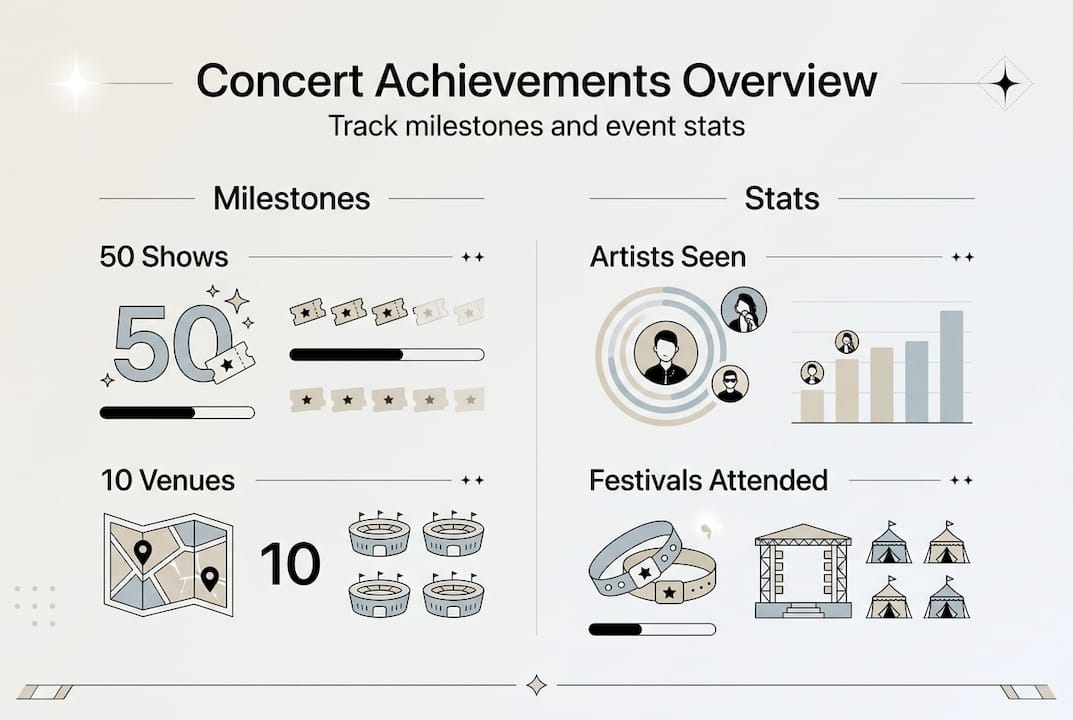
Here's how the landscape breaks down:
| Achievement type | Where you'll find it | Notes |
|---|---|---|
| Total concerts attended | All major platforms | Most common stat |
| Unique artists seen | Setlist.fm, Concert Archives, Encore | Counts each artist once |
| Venues visited | Most platforms | Tracks location diversity |
| Explicit badges | Niche apps only | Rare in mainstream tools |
| GPS-verified attendance | ConcertCritic | Strictest verification |
The badge question is worth addressing directly. No explicit badges exist in mainstream platforms like Songkick, Setlist.fm, or Concert Archives, but your stats effectively serve as achievements. Niche fan sites like Phish.net are the exception, offering explicit badges for things like reviewing 50 shows.
For verification, GPS check-ins via ConcertCritic are the strictest option available. Most other platforms rely on the honor system, which works fine for personal tracking but matters more if you're chasing official records.
Festivals are a gray area. Many platforms count each festival as one event, not multiple shows. And for official record attempts, festivals are typically excluded entirely. So if you're gunning for a personal record, solo headline shows are your best bet.
Key takeaway: Your stats are your achievements, even without a badge system. Hitting 50 shows, visiting 10 venues, or seeing 30 unique artists are all milestones worth celebrating.
Achievement in action: World records and superuser stories
The technical details are useful, but the real inspiration comes from fans who've pushed concert tracking to its limits.
Tim Schaefer's story is the most dramatic example. He attended 289 verified concerts in a single year, earning a Guinness World Record in 2025. That's nearly one show every day, and every single one was documented.
"The record wasn't just about the number. It was about proving that live music could be a way of life."
But you don't need a world record to feel the impact of tracking. Here's what dedicated fans are doing with their concert logs:
- Lifelong documentation journeys, with some users logging 94 or more shows with detailed reviews for each
- Artist-specific tracking, following a single band across dozens of cities and setlist variations
- Venue bucket lists, working through a personal list of legendary spots to visit before they close
- Community motivation, where sharing milestones on tracking platforms inspires friends to attend more shows together
It's worth noting that apps get mixed reviews. Fans love the stats but sometimes run into crashes or clunky interfaces. That's a real consideration when choosing your platform. The best app is the one you'll actually use consistently.
How to get started with your own live show achievements
Enough inspiration. Here's how to actually begin building your concert legacy, starting today.
Concert Archives, Setlist.fm, Encore, and ConcertCritic all offer different entry points depending on your goals. Pick the one that fits your style, then follow these steps:
- Choose your platform. Want deep stats? Try Concert Archives. Love community setlists? Go with Setlist.fm. Prefer memory-keeping with friends? Gigvault is built for that.
- Migrate your past concerts. Use old ticket emails, Ticketmaster order history, or even your own memory to backfill your show history. Every show counts.
- Set your first milestone. Maybe it's logging your first 10 shows, or visiting a new venue, or seeing a new artist. Small goals keep you motivated.
- Upload photos and notes. A quick caption about how the crowd felt or what song hit hardest makes your archive genuinely personal.
- Share your milestones. Post your 25th show, your first festival, or your favorite setlist. Connecting with other fans is half the fun.
Pro Tip: Use the best tracking app for your specific goal rather than trying to do everything in one place. A stats-focused fan and a memory-focused fan have very different needs, and the right tool makes all the difference.
The most important thing is to start. Every show you've already attended is a milestone waiting to be logged.
Take your concert journey further with Gigvault
If you're ready to go beyond raw stats and build something that actually feels like your concert story, Gigvault was made for exactly that. It's a personal concert memory platform where you can log every show, upload photos and videos, track your favorite artists and venues, and get personalized insights like your top cities, achievement highlights, and AI-generated Music Identity.
Unlike traditional tracking apps, Gigvault focuses on the emotional side of live music. You can connect with fans who share your concert history, plan shows with friends, and keep everything organized in one private archive. Explore Gigvault's full features to see how it all fits together, or check out artist-specific pages like The Journey Back concerts to start logging your history with the artists you love most. Your concert legacy deserves more than a spreadsheet.
Frequently asked questions
Do mainstream concert apps have actual achievement badges?
Most mainstream apps track stats like concerts attended or artists seen, but explicit badges are rare and mainly found in niche fan platforms like Phish.net. Your cumulative stats effectively function as your achievements.
Can I verify my concert attendance in these apps?
Yes, though it varies by platform. GPS verification is available through ConcertCritic, but most other platforms like Setlist.fm and Concert Archives rely on the honor system for logging attendance.
Which platform should I use to start tracking my live show achievements?
Popular choices include Setlist.fm, Concert Archives, Encore, and Gigvault. Choose based on whether you prioritize stats, community setlists, memory-keeping, or social connection with other fans.
Do festivals and multi-artist events count toward my achievements?
It depends on the platform and context. For official records, festivals are typically excluded, but most personal tracking apps count them as individual events. Always check the specific rules of the app you're using.